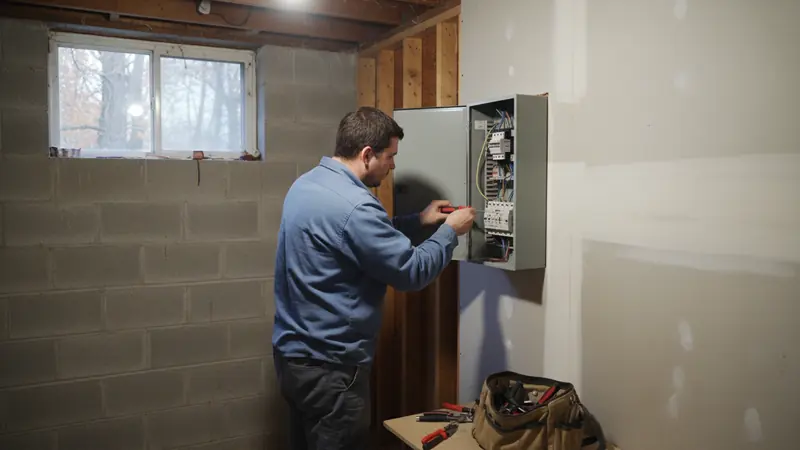
What you need to know about electrical repairs in Loudoun County. Permit charges. Inspections before the walls close. Trouble recorded in local homes.
We've dated every figure we found. We've labelled published targets, historical estimates and calculated examples so you can tell them apart.
Do you actually need a permit?
You need a permit for new wiring or alterations unless a specific exemption applies. Adding a circuit, changing service equipment or wiring a basement needs a permit.
Virginia's ordinary-repair exemption lets you replace general-use switches, dimmers, lighting fixtures, ceiling fans and 125-volt, 15- or 20-amp receptacles. It covers the residential occupancies specified in the regulation, including individual apartment units and houses. It does not let you extend wiring or add outlets. You must still follow the code for exempt work. The building official may require permits for otherwise exempt work in a special flood hazard area.
For an emergency alteration or equipment replacement, you can start work before applying for the permit. You must submit the application by the end of the next working day. An emergency does not remove the permit requirement.
Source: Virginia Board of Housing and Community Development, 13VAC5-63-80, Section 108, Application for permit, particularly 108.1 and 108.2(14.3); current amendment effective 2024-01-18. Gathered 2026-09-22.
Loudoun's electrical application asks about service amperage, subpanels, circuits, generators, vehicle chargers and photovoltaic systems. Describe the whole job. A charger installation with a service change involves more than the charger alone. The form says you may need plans. You cannot assume every residential application can go ahead without drawings.
You can apply online through LandMARC. The county also publishes paper forms you can post. It does not accept those forms by email or fax. Have the job address, property identification number, owner details, contractor information and work description ready. For application questions, Building and Development's published number is 703-777-0220.
Source: Loudoun County Department of Building and Development, Electrical Permit Application, form dated 2017-07-13 and still linked by the county; Building & Zoning Permit Application Forms, undated. Gathered 2026-09-22.
What the permit costs
The county's current fee page links the schedule effective July 1, 2022. The electrical charges also appear in the published county ordinance. These are county charges. They are not an electrician's price for obtaining the permit or doing the work.
| Electrical work or fee item | Published charge |
|---|---|
| Service equipment, 0–400 amps | $70 |
| Service equipment, above 400 amps | $100 |
| Subpanel | $40 each |
| Fixtures, receptacles and circuits: one- and two-family dwellings | $70 |
| Fixtures, receptacles and circuits: commercial | $100 |
| Motor or generator | $40 each |
| Electric heating and air conditioning | $25 each |
| Additional electrical reinspection | $30 each |
The electrical fee includes two inspections. That tells you what the fee covers. It does not mean every job follows the same inspection sequence.
Watch the minimum charge. The schedule sets a $65 minimum per permit. We read the $40 and $25 entries as parts of a fee subject to that minimum. We do not read them as standalone permit totals. We could not calculate a combined service, subpanel and circuit invoice. The documents do not explain every combination. You can confirm the fee category and total with Building and Development at 703-777-0220.
Check how the levy appears on your invoice, too. Virginia requires a 2% code-academy levy on permit fees. Suppose the county adds the levy to a $70 base. That gives $70 + $1.40 = $71.40, before any card charge. We have not verified this added-levy example against a Loudoun invoice. The county schedule does not clearly say whether its displayed amounts already include the levy. Before you rely on that total, confirm how the county handles it with Building and Development at 703-777-0220.
Online card payments carry a 2.65% convenience fee. The county also lists cash and cheque as payment methods. Keep the county invoice separate from contractor charges for preparing the application, drawings or attending inspections. Otherwise, you will struggle to compare a quote labelled “permit” with the public schedule.
Source: Loudoun County Department of Building and Development, Application Fee Schedule, pages 8, 10–11, effective 2022-07-01; Loudoun County, Building and Housing Code Appendix A, effective 2022-07-01; Virginia Board of Housing and Community Development, 13VAC5-63-70, Section 107.2, current amendment effective 2024-01-18; county Fee Schedules and Payment Options, undated. Gathered 2026-09-22.
How long the permit actually takes
Loudoun publishes the stages below. It does not give a measured median for electrical-permit times:
| Stage for residential trades | County's published expectation |
|---|---|
| Intake and application completeness check | 2–5 business days after application |
| Trade permit review, after intake and payment | 2 days |
The county processes applications by application date. Its residential dashboard shows dates waiting for intake. A blank date means applications through that day have been assigned for processing. They are being processed. It does not mean they have all been approved.
Check what “days” means. The intake text says “business days”. The review table says “days.” Those different terms do not give you a guaranteed completion date. Check how the county counts review days through its Residential Permits Processing Dashboard and permit-status inquiry link. You can also check your application's status there.
We could not verify a county-specific median or percentile for the time from application to permit issue. You may still need corrections, payment or the permit itself after review. Do not treat the review target as a promise about when you can start work.
The county's payment instructions conflict. Its general fee page says it issues invoices at intake. Those invoices must be paid before review. Its finished-basement page says payment follows completed review. Check this before it holds up your application.
Our reading: for an electrical application, follow the general fee page and dashboard sequence. Intake comes first. Payment follows. Review comes after payment. If LandMARC shows a different sequence for a linked basement project, confirm it with Building and Development at 703-777-0220.
Source: Loudoun County Department of Building and Development, Residential Permits Processing Dashboard, Fee Schedules and Payment Options, and Finished Basements, all undated live pages. Gathered 2026-09-22.
The inspections
When you finish a basement, concealed electrical work must pass its rough-in inspection before the building framing inspection. You need framing approval before you cover anything up. Insulation needs its own inspection before you close the walls and ceilings. You also need electrical final approval to complete the project. Plan your work around those stages, rather than the drywall delivery.
Keep approved plans or the county's applicable basement details on site, electronically or on paper. The county says it will not inspect without them. Missing plans can mean a failed visit even when your wiring is ready.
Book electrical inspections in LandMARC. You can also find inspector information, cancel bookings or check results there. To request the following working day, book by midnight. You can request future dates, except weekends and county holidays.
Inspections run 8:30 a.m.–3 p.m., Monday–Friday. You can reach inspectors in the office 8–8:30 a.m. and 3–4 p.m. The inspection and building-code contact is 703-777-0220, option 1. You can use those office hours to discuss a correction. They do not promise when an inspector will arrive.
The county may charge for another inspection if your work is not ready. Before you book, check that the necessary work is complete. Make sure the inspector can reach it. Leave wiring visible where you need a rough-in inspection. Keep the final result with your permit documents. Do not rely solely on a contractor saying the job passed.
Source: Loudoun County Department of Building and Development, Finished Basements, inspection requirements, and Building Inspections, scheduling and contact details; both undated. Gathered 2026-09-22.
What the inspector is actually going to check
Loudoun's basement guidance gives you dimensions to check as you plan a room:
- Panel access: do not put a panel in a clothes closet. Leave 36 inches in front of the enclosure. Allow 30 inches of workspace width.
- Receptacle layout: leave no more than 12 feet between outlets. Allow no more than 6 feet from doorways or fireplaces. Provide an outlet for each wall space 2 feet or wider. Measure along the wall line.
- Hallways: those 10 feet or longer need a receptacle.
- Bathrooms: provide a receptacle beside each lavatory. Provide ground-fault protection. Use a 20-amp circuit dedicated to bathroom receptacles.
- Devices: use tamper-resistant receptacles, as the guide requires.
These are some of the basement requirements. They are not a complete checklist for service replacements, pools or chargers.
Take care with the guide's shorthand. It describes circuits as AFCI-protected “or” GFCI-protected where code specifies. We do not read that as permission to choose either protection. The rules for the circuit and location decide what you need. Confirm your design with county inspections at 703-777-0220, option 1.
Source: Loudoun County Department of Building and Development, Finished Basement Guidelines, dated 2025-04-16, electrical guidance on page 3; county Building Inspections contact page. Gathered 2026-09-22.
- 1No panel in a clothes closet. Leave 36 inches in front of the enclosure and 30 inches of workspace width — a heavy-up that fits the wall but not the clearance fails on the measurement, not the equipment.
- 2No more than 12 feet between outlets, no more than 6 feet from doorways or fireplaces, and an outlet for each wall space 2 feet or wider. Measurements follow the wall line. Hallways 10 feet or longer need one.
- 3Service equipment is $70 up to 400 amps and $100 above it, with a subpanel charged at $40 each — so the size of the service decides the fee before any of the work does.
- 4Bathrooms need a receptacle adjacent to each lavatory, ground-fault protection, and a 20-amp circuit dedicated to bathroom receptacles. Receptacles must be tamper-resistant.
Loudoun County Building and Development residential electrical guidance; Virginia DHCD, 13VAC5-63. Gathered 2026-09-22.
Who is allowed to do the work
Check the business's credentials. Check the person doing your electrical work separately. Virginia DPOR distinguishes a contractor business license from an individual tradesman license. The business licence's class sets the value of work it can undertake. Its classification or specialty sets the kind of work. ELE is the electrical contractor classification. Being told someone is “licensed” does not settle those questions.
Loudoun's hiring guidance says contractors listed on building applications need a valid Virginia contractor licence. They also need local business licensing. The detailed instructions direct contractors working inside an incorporated town to that town's BPOL licensing. A BPOL receipt concerns business tax. The county expressly says it does not certify workmanship.
Use the county's link to DPOR's licence lookup to check the business name or licence number. Check disciplinary information there too. Make sure the contract names the actual licensed business, rather than just an advertising name.
If you're an eligible owner, you can apply under a licence exemption. Loudoun publishes a Statement of Owner/Lessee License Exemption. One statutory route covers work on no more than one primary residence owned for the person's own use in a 24-month period. Other exemptions have different conditions. Owning the property does not automatically qualify you for every arrangement.
If you sign the county form, you take responsibility for the construction. You must also ensure anyone you hire follows licensing laws. An owner exemption does not remove your duty to follow the code. You still need permit inspections. It does not give an unlicensed hired contractor a licence. Settle who will hold the permit before you sign the work contract.
Source: Virginia DPOR, Board for Contractors and License Classifications and Specialties, undated; Loudoun County, Hiring a Contractor, undated, and Statement of Owner/Lessee License Exemption, dated 2018-06-12; Virginia General Assembly, Code of Virginia §54.1-1101, current text. Gathered 2026-09-22.
Which code your job is held to
Loudoun currently lists the 2021 Virginia Uniform Statewide Building Code, the 2021 Virginia Residential Code and the 2020 National Electrical Code, NFPA 70. Virginia's adoption took effect January 18, 2024.
The year on a new code book does not tell you what Loudoun enforces. Virginia's adopted editions and amendments matter. For repairs or alterations, the county also lists the Virginia Existing Building Code. The requirements depend on your work and building. If you dispute a correction, ask for the code section and applicable edition. That gives you the actual requirement to discuss.
Source: Loudoun County Department of Building and Development, Building Codes and Regulations, undated current list; Virginia Department of Housing and Community Development, Codes, adoption effective 2024-01-18. Gathered 2026-09-22.
What Loudoun County houses are, and what goes wrong in them
Loudoun has both recent construction and older homes. The county's draft FFY 2026–2030 Consolidated Plan, table 30, gives this historical breakdown:
The numbers behind this
| Year built | Owner-occupied homes | Renter-occupied homes |
|---|---|---|
| 2000 or later | 53,292 | 12,025 |
| 1980–1999 | 34,671 | 11,787 |
| 1950–1979 | 11,794 | 4,465 |
| Before 1950 | 3,208 | 1,238 |
| Total | 102,965 | 29,515 |
Loudoun County Office of Management and Budget, Housing Units: 2025 Estimate Series, August 2025. Gathered 2026-09-22. The total row is left to the table: charting a sum beside the parts that make it up compares a thing with itself.
These are historical estimates. The table attributes its figures to 2016–2020 CHAS data. The document is still marked draft. We cannot give an effective adoption date. The figures count occupied homes, not all housing units. The plan covers a future period. That does not make its housing data current.
There is only so much you can infer from these figures. Loudoun has substantial newer housing. Do not assume every repair involves obsolete wiring. A newer home cannot tell you what later owners added. Age alone cannot establish your home's wiring material, available electrical capacity or safety. We found no countywide primary-source figures for how common aluminum branch wiring, defective panel brands or unpermitted electrical alterations are.
Source: Loudoun County Department of Housing and Community Development, draft FFY 2026–2030 Five-Year Consolidated Plan, table 30, printed page 96; underlying data labeled 2016–2020 CHAS. Gathered 2026-09-22.
An extension cord feeding a space heater caused a local fire. Loudoun Fire and Rescue published its report on October 4, 2025. It attributed a Leesburg house fire to an overheated light-duty extension cord. Officials estimated $65,000 damage to the home. They estimated $15,000 smoke damage to an adjoining unit. These are estimates for that incident. They cannot tell you what your repairs will cost.
The county's advice follows from that finding. Plug major appliances and space heaters directly into suitable wall receptacles. Do not use extension cords or power strips in place of permanent wiring. The county also recommends 3 feet of clearance around portable heaters. Turn them off when you leave the room or go to bed.
That investigation tells us what happened in a local home. It does not tell us how often the same fault occurs across Loudoun. It cannot justify calling this the county's leading electrical problem.
Source: Loudoun County Fire and Rescue Fire Marshal's Office, Leesburg House Fire that Displaced Three Ruled Accidental and Prompts Important Fire Safety Warnings, published 2025-10-04. Gathered 2026-09-22.
Water-damaged electrical equipment needs a separate assessment. Virginia's property-maintenance rules require you to replace specified electrical equipment exposed to water under the Existing Building Code. There are limited exceptions allowing reuse. You need an inspection report from one of the specified qualified parties to meet those exceptions. Drying equipment out is not enough, even if it still works. Tell your electrician about water exposure before you agree to a simple device replacement.
Source: Virginia Board of Housing and Community Development, 13VAC5-63-540, Chapter 6, Mechanical and electrical requirements, particularly 604.3.1.1; current amendment effective 2024-01-18. Gathered 2026-09-22.
What the work is worth
We could not find county-specific installed prices in a primary public source for panel replacement, service upgrades or charger circuits. We could not find them for electrical fault diagnosis either. So we cannot give you a sourced price range.
Ask for a written quote that identifies the problem or intended addition. Get the included equipment and wiring listed. Ask what it covers for access and wall repairs. Settle who handles the permit. Agree who attends inspections. Get responsibility for corrections in writing. For a charger or new appliance, separate the installation you requested from any proposed service work. Ask why you need that extra work. A larger total may cover more work. A smaller total may leave essential items for someone else.
The county application records service rating, circuits, subpanels and individual equipment separately. That helps you compare the work quoted. It does not give you prices. Compare quotes against the same work description. Check them against the actual county invoice too. Do not assume every “electrical upgrade” is the same job.
Source: Loudoun County Department of Building and Development, Electrical Permit Application, dated 2017-07-13, for scope fields only. No county-specific primary-source installed-price series was verified. Gathered 2026-09-22.
The short version
Check whether your job is an exempt replacement or an alteration. Describe the whole job on the application. Check the contractor's credentials. Distinguish the scheduled fee components from your final invoice. Allow for intake before review. For concealed wiring, arrange inspection before you close up the room. Keep the final approval with your house records.
Loudoun's published details can help you make those decisions. Where the documents leave a question open, we have said so. We have not filled the gaps with unsupported numbers.
Source: Loudoun County Department of Building and Development, Electrical Permit Application, Fee Schedules and Payment Options, Residential Permits Processing Dashboard, Finished Basements and Hiring a Contractor, linked above; Virginia Board of Housing and Community Development, 13VAC5-63-80, linked above. Document dates and effective dates are stated in the relevant sections. Gathered 2026-09-22.